

[The first page of this letter is missing. It likely relates to a conversation with Mrs. Lee. Assumed date: Nov 22 1893]
Margaret Winthrop Hall.
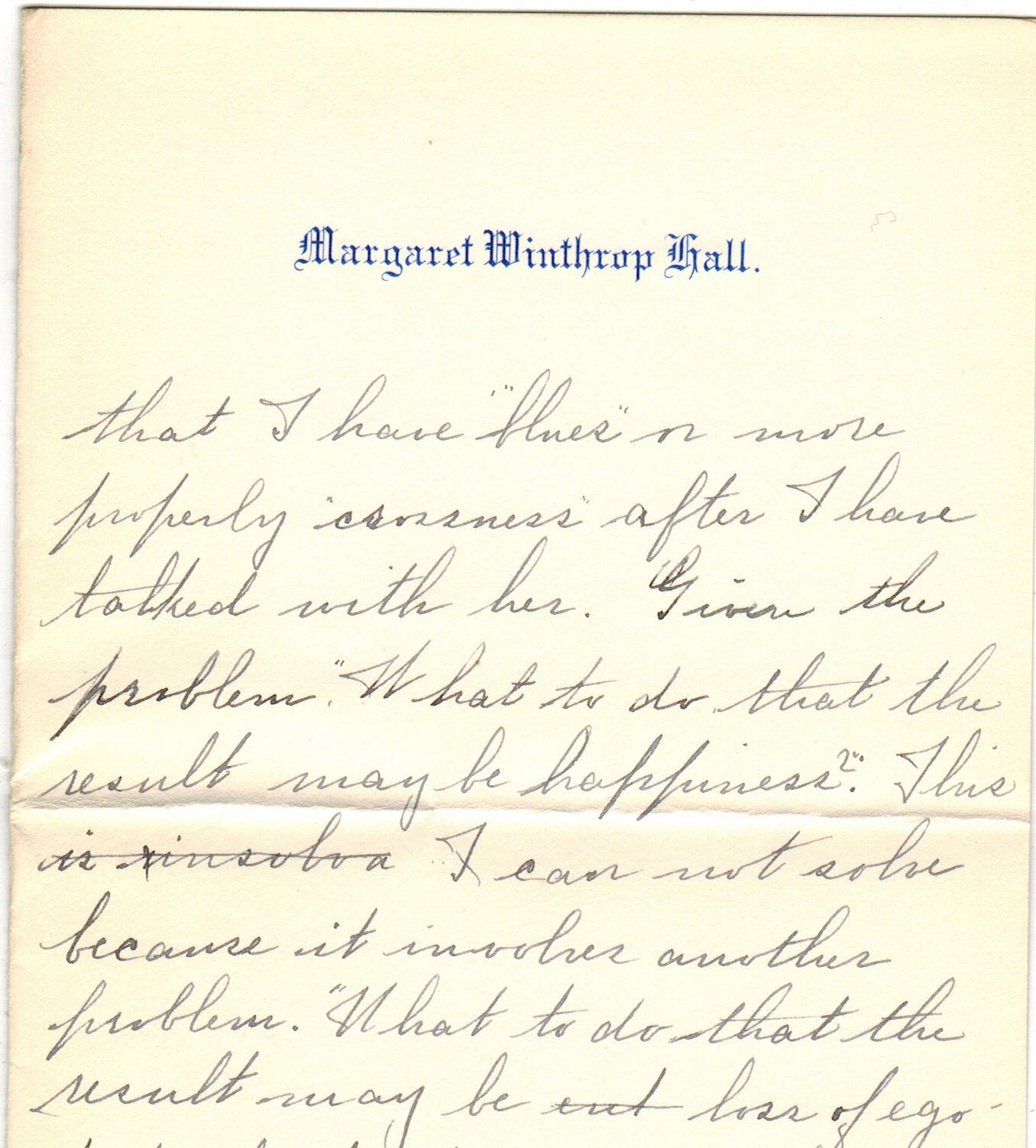
...that I have “blues” or more properly “crossness” after I have talked with her. Given the problem “What to do that the result may be happiness?” This I can not solve because it involves another problem. “What to do that the result may be loss of egotistical traits,” and as long as people say I am “queer,” “odd,” “funny,” “Chinese puzzle” and so forth I shall be introspective.
I think my writing is ever so funny. Miss Warren, the English teacher in the Cambridge School said there was no character in my writing and so since I am in Cambridge to improve, I am trying my best to change it.
The photograph which you sent pleases me immensely but I do not know why. I know very little concerning ways and means of reaching Somerville from Boston. It is one of Boston’s many suburbs and about as far as Cambridge. Shall go over to S sometime this week and write you there.
Please do not think any the less of me for being so cross and queer,
Ethel Bottum.
Editor’s Note
The first page of this letter is missing. From context, it appears to follow a conversation with Mrs. Lee — one that left Ethel unsettled.
What remains is unusually self-revealing.
At sixteen, newly installed at Margaret Winthrop Hall and attempting to “improve” herself in every respect, Ethel writes as though her own disposition were a problem to be solved. She quotes others’ descriptions of her — “queer,” “odd,” even a “Chinese puzzle” — and wonders what must be altered in order to secure happiness and shed what she calls “egotistical traits.”
The accumulation of labels suggests that Ethel feels herself observed, assessed, and corrected.
There is an echo here that recurs. Morris has just teased her about her handwriting. Now she reports that a teacher has told her there is “no character” in it — and she is trying to change. Handwriting, personality, temperament: all seem open to revision.
If Morris’s previous letter allowed a glimpse of dissatisfaction beneath cheerfulness, this one reveals something equally fragile beneath Ethel’s brightness: the strain of being young, perceptive, and alone in a setting not merely educational, but reformative — a place where identity itself is expected to be shaped.
She closes with a plea not to be thought less of.
New here? Start with the Welcome, or navigate the correspondence through the Letters Index.
[TLC-1893-44]